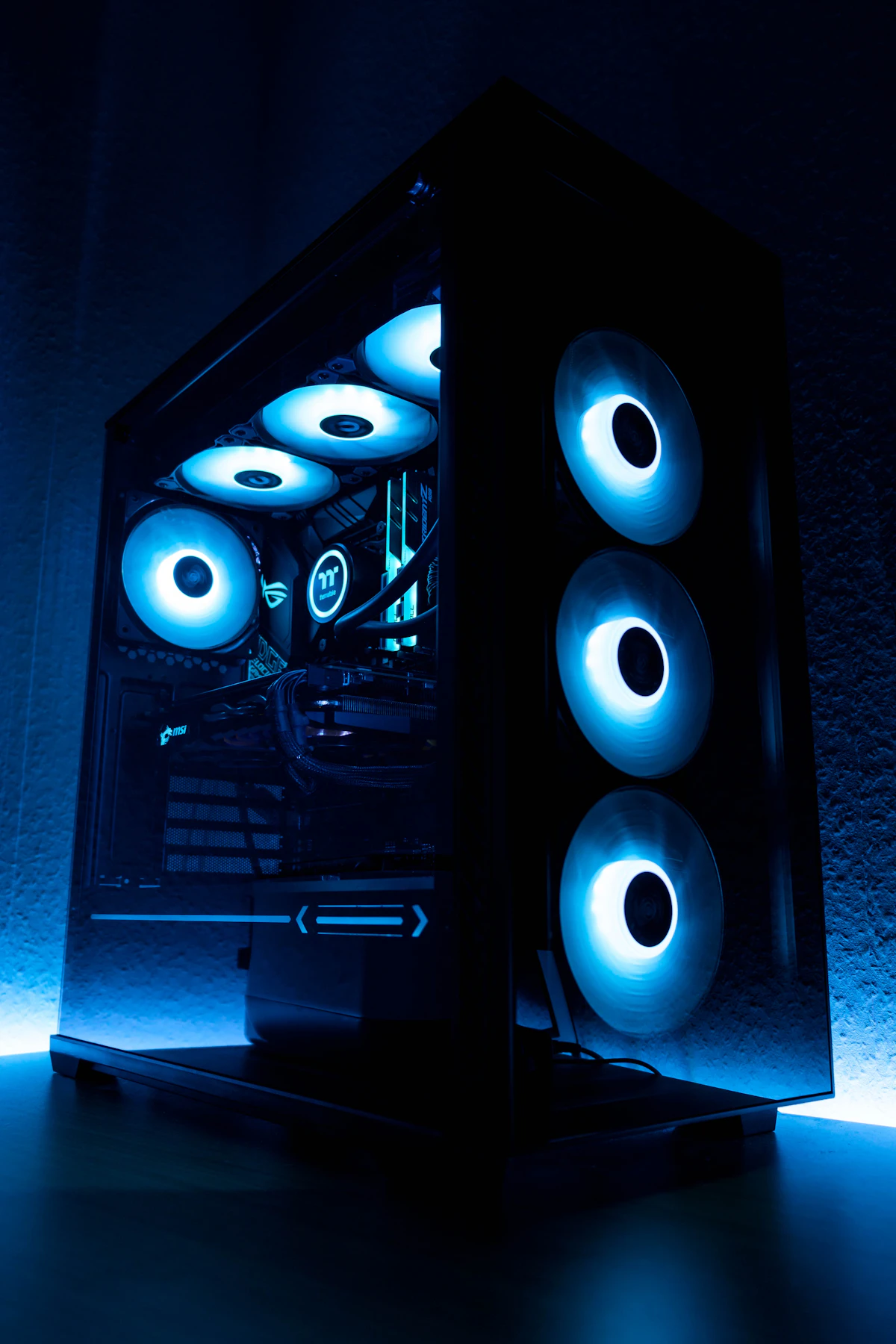
Consumer desktop ATX power supplies are engineered around intermittent residential usage profiles—handling short gaming sessions and burst workloads with quiet, slow-spinning fans. When subjected to continuous 24/7/365 loads with five to eight graphics cards, consumer ATX units quickly suffer capacitor degradation and internal thermal fatigue.
Enterprise server power supplies—manufactured by companies such as HP, Delta, and Lite-On for 1U and 2U server chassis—are designed from the ground up for continuous high-load duty cycles. Bearing 80-Plus Platinum and Titanium efficiency certifications, these power supplies deliver up to 94% to 96% power conversion efficiency when operated on 200V to 240V mains electricity (standard throughout South Korea).
To utilize a server power supply on an open-air multi-GPU rig, a breakout board is connected to the proprietary edge connector. Quality breakout boards feature solid-state capacitors, integrated digital voltage readouts, multiple 6-pin PCIe output ports, and synchronization lines (such as floppy 4-pin or Molex sync cables) that trigger the server PSU to power on simultaneously with the primary ATX motherboard.
During our Component Selection classes, we examine breakout board trace quality, verifying copper thickness (at least 2oz copper) to ensure the board can handle 100 Amperes of continuous 12V current without trace delamination. We also inspect electronic short-circuit protection and over-voltage trip relays.
By combining a modest 450W ATX power supply for the motherboard and CPU with a 1200W/1400W server power supply for the graphics cards and risers, builders achieve industrial-grade reliability, modular cable management, and significant cost savings compared to expensive multi-kilowatt consumer power bricks.